win%3Dalliance-networking-session
win-alliance-white
win-herastrau-win-real-estate
win%20real%20estate
win-brokers-broler-bucuri-de-lux
win-brokers-white
win-tireanu-motorsport-win-alliance%20copy
win-motorport-logo-alb

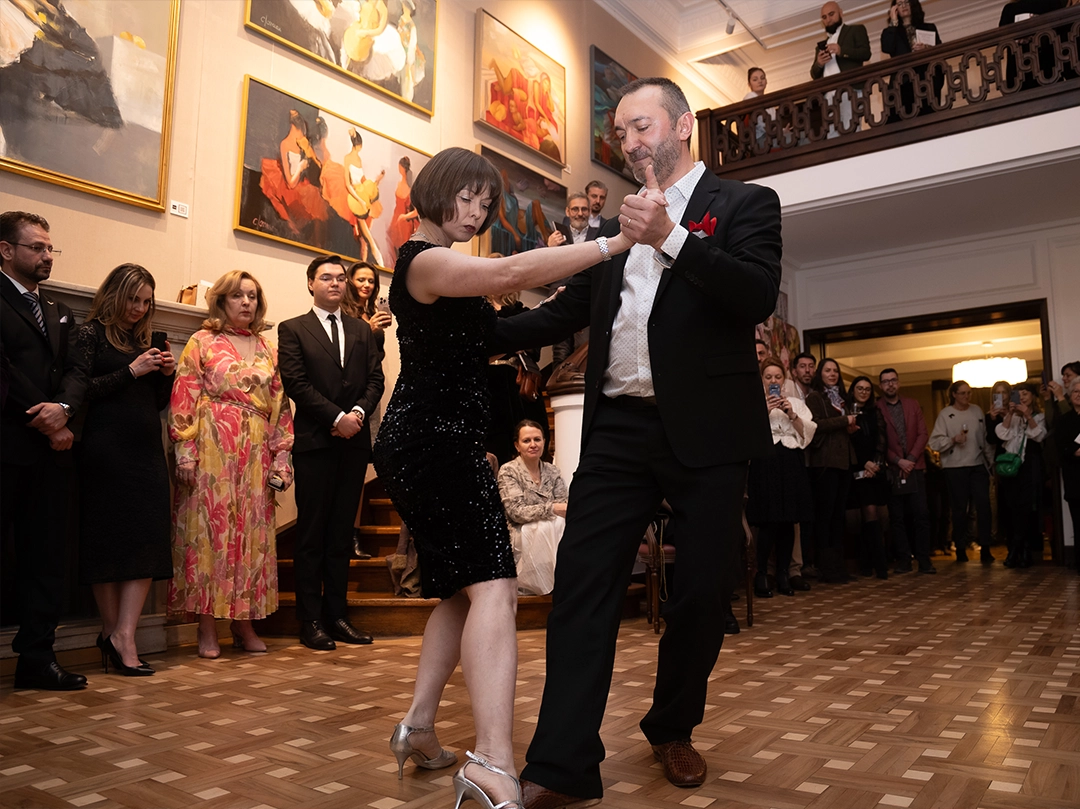
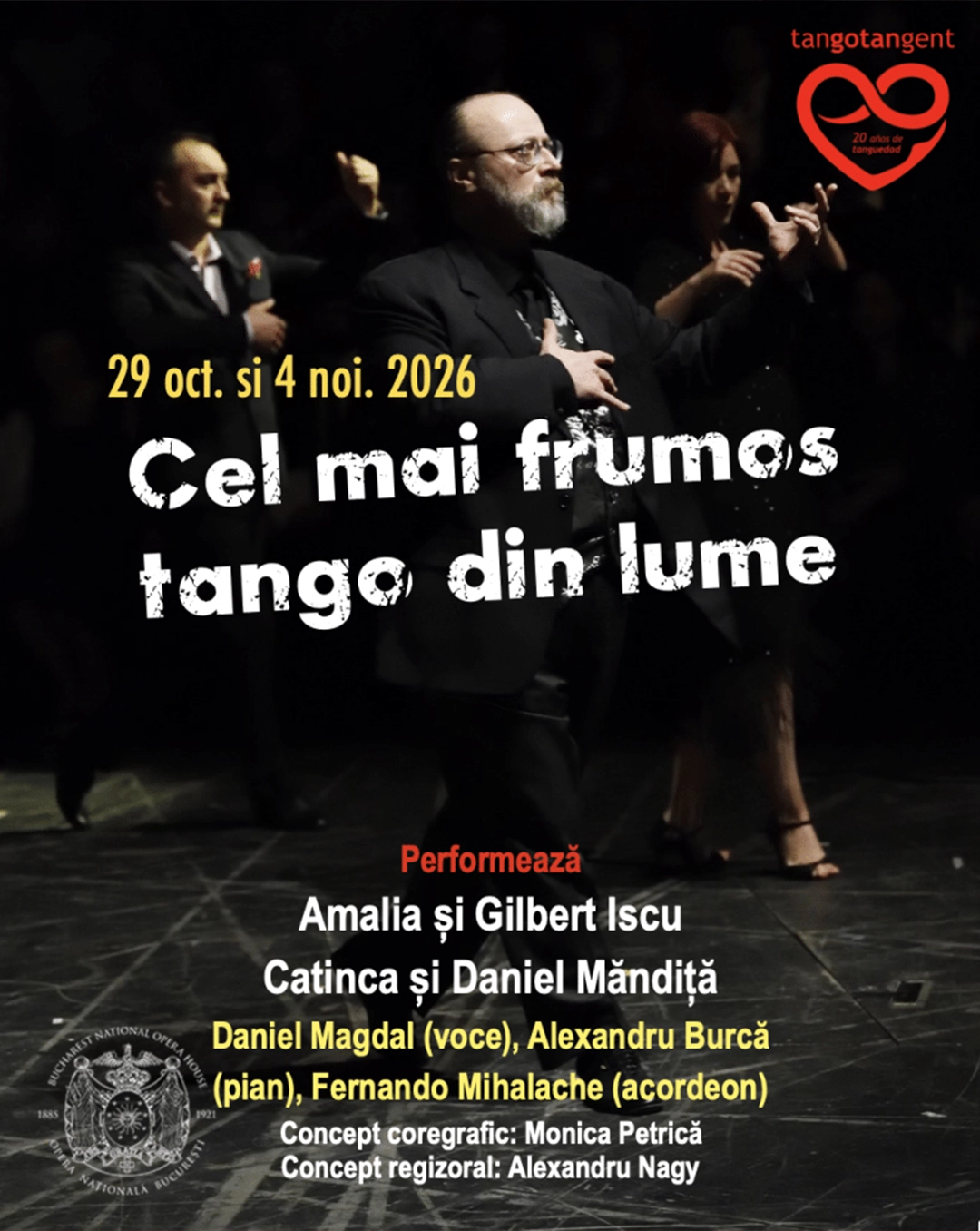
The quality of their artistry and their passion for teaching are two key aspects that define the work of Dan and Catinca Măndiță, two of the instructors at the renowned Argentine tango school in Bucharest, TangoTangent. This school, founded by three enthusiasts of an art form in constant reinvention (Daniel Măndiță, Amalia Iscu and Gilbert Iscu), has trained hundreds of dancers over more than 20 years. In this exclusive interview, Dan and Catinca talk about their vision of ‘Romanian’ tango, and about femininity and improvisation as a way of dancing and living. 

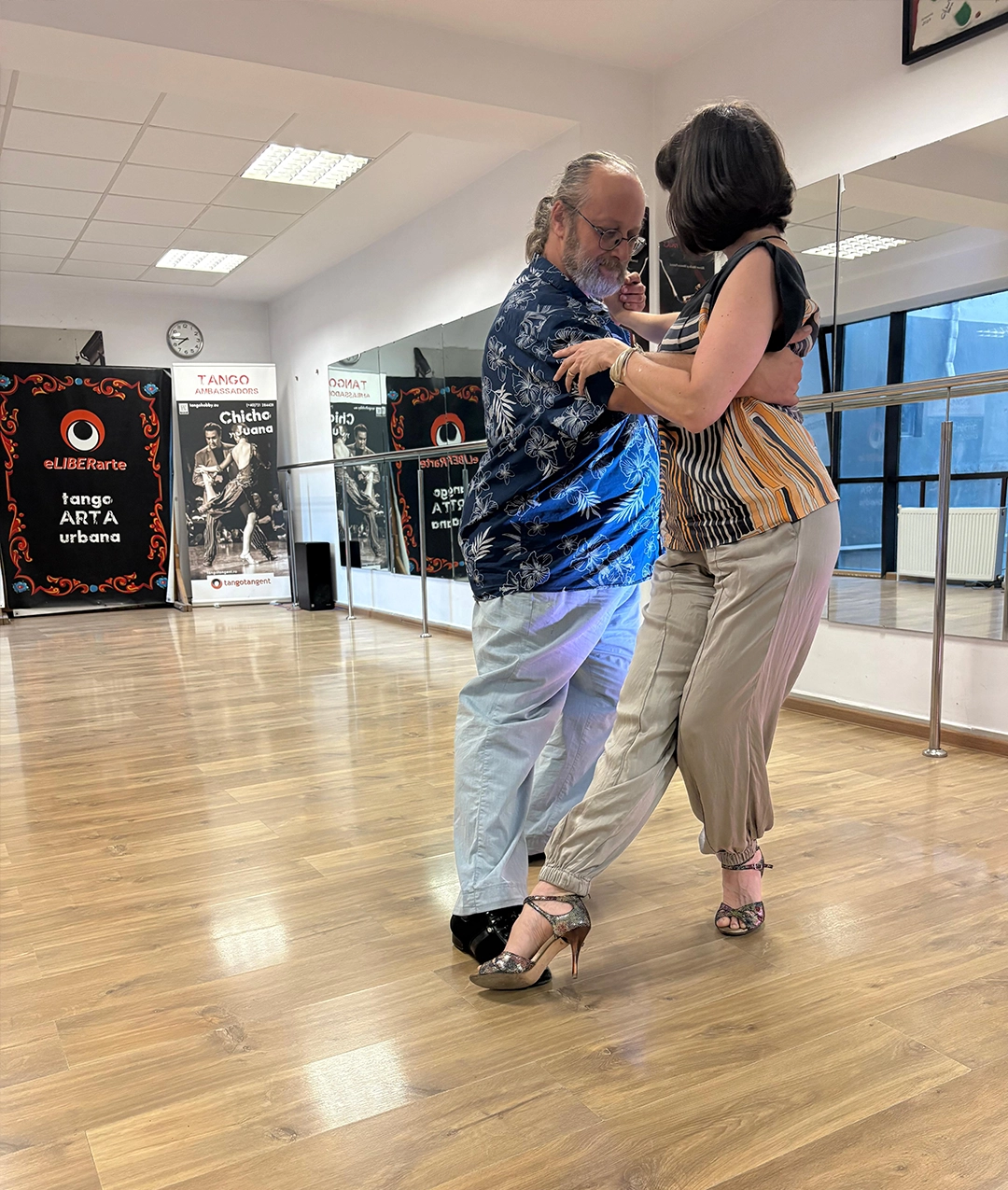
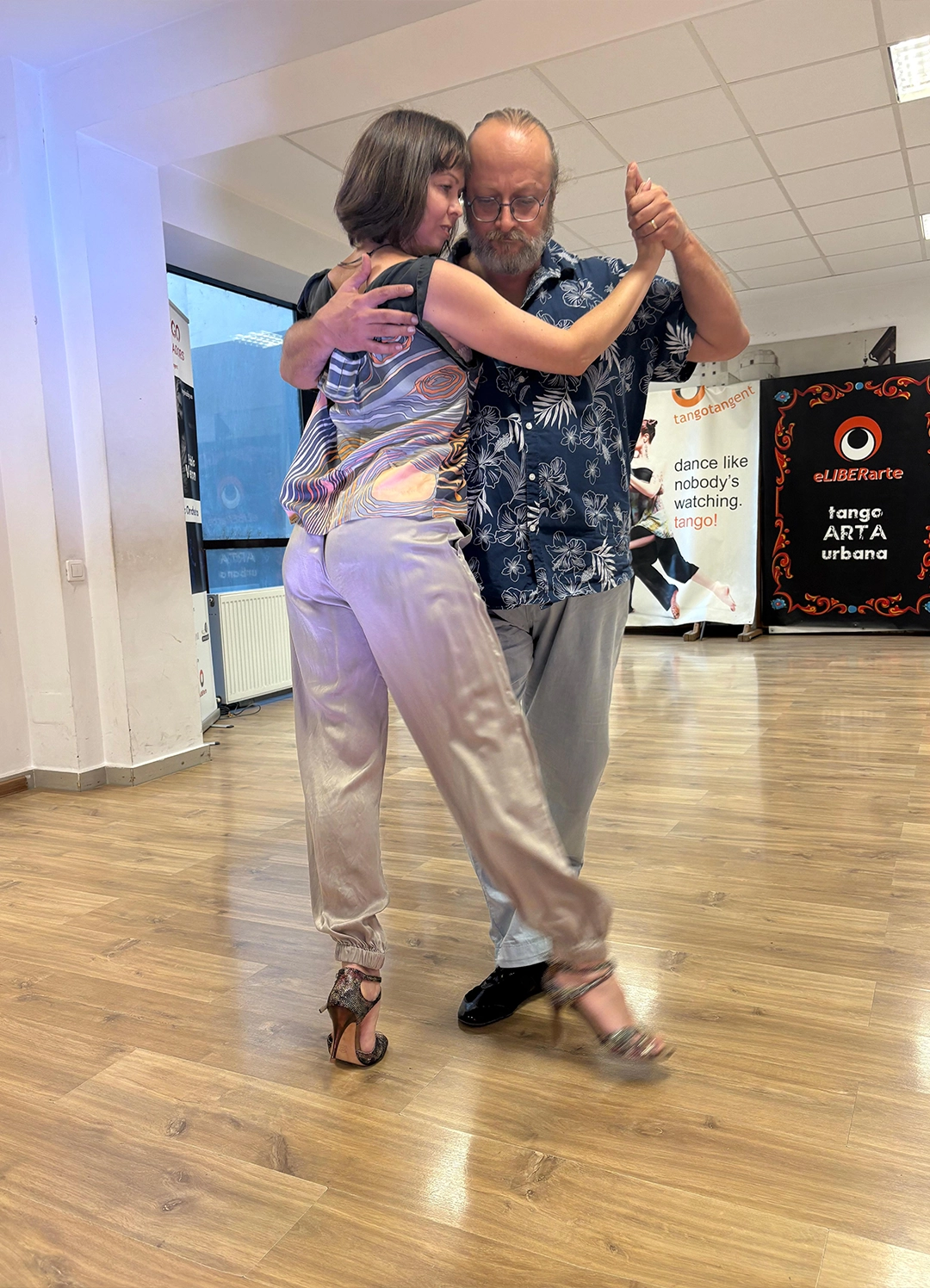
dan-and-catinca-02 dan-and-catinca-02

Dan and Catinca Măndiță at the TangoTangent studio, Bucharest, September 2026

WIN Gallery: What’s the story behind TangoTangent? 

D.M.: My – or rather, our – encounter with dance, as the founders of this group, was purely by chance. Just a happy ‘accident’, or a coincidence. At one point, without any intention on my part, I ended up taking part in a series of dance classes. To my amazement, I discovered that I actually enjoyed it! But it wasn’t until a few years later that I discovered Argentine tango. And that’s when it really clicked: I realized I absolutely loved it. Then, over time, together with the other two founders of our school – and our club – Amalia and Gilbert Iscu, we decided to start teaching as well. At one point, when things had already become quite serious, we decided to focus more on performances. We were preparing a magnificent show at the time, that would remain in the Odeon Theatre’s repertoire for ten years, ‘Un tango más’. So, in a way, looking back, it was all a happy series of ‘accidents’. Twenty years have passed since then, and here we are, all three of us still delighted to keep building on what we’ve started. 

C.M.: I joined TangoTangent a few years later and, from what I’ve gathered from stories about the early days, the name TangoTangent originated from a joke directed at the founders. Perhaps that was a way of saying they had fresh ideas about Argentine tango, about how it could be taught and what it should represent for those discovering and learning it. This different perspective was seen, in a way, as a departure from what was considered to be traditional tango at the time, as a form of ‘tangent’ to the established style. And, if I’ve understood the story correctly, it was precisely this observation – which started out as a joke – that ended up inspiring their name: TangoTangent. 


WIN Gallery: What was - and still is - important to you in the context of TangoTangent: the quality time that is offered to students, memorable experiences or, above all, improving dance technique? 

D.M.: For me, the most important aspect is improving dance technique. The experiences come afterwards. Once you can dance, you can enjoy a whole range of experiences; you can feel a whole range of emotions whilst moving.  

C.M.: For me, it’s primarily about connection and experiences. I recognize, of course, that it takes a lot of hard work, but under the guidance of the three founders, my efforts have led to unexpected results. Together, we’ve built something that isn’t lost, doesn’t fade away, and doesn’t go out of date. The response and the joy are immediate; they’re right there, you feel them with you, inside of you. You feel an extraordinary joy when you experience the sensation of moving in the rhythm of music, in harmony with the music, and of having achieved something meaningful together with another person, with another body. It’s not just a mental or rational sensation; it’s emotional, but also physical at the same time.  


WIN Gallery: Can tango drastically change one’s outlook on life? Some enthusiasts have said that, for them, it marked a new ‘beginning of life’. 

D.M.: Tango really does change your outlook and brings you into contact with experiences which, under different circumstances, you  might not have had the chance to discover. It brings you into direct contact with others, but also with your own body. You learn to have more confidence in yourself and to build a different relationship with the way you move, with your own gestures and with the way you get to know others; not just verbally, but - above all - kinetically, physically. And all of this changes many things. People are transformed: they modify their posture, the way they walk, the clothes they wear, the way they present themselves and the way they approach others. You become more forgiving of the mistakes of those around you, because you know that, sooner or later, you’ll find yourself in the same situation. You learn to be more helpful. There is, in fact, a whole tradition in tango whereby more experienced dancers support those who are just starting out. 

Then there is the lesson of the two roles. When you dance in a particular role, you must commit to it fully, understand the responsibility it entails and be fully present in your relationship with your partner. Ultimately, tango teaches you not only to dance, but also to relate differently to yourself and to others. 

C.M.: There are also many people who have come to use tango in very different contexts and for very different purposes. Some integrate it into therapy-like practices. Others use it in a business setting to better understand how they collaborate with their colleagues and partners, how they take on responsibilities, or how they step out of the comfort zone.   

Beyond these applications, however, I believe that the dance itself - the process of learning and working with your own body – changes the way you relate to things. You end up feeling more at ease with yourself, anticipating certain mistakes before they happen, and no longer being so taken aback when something doesn’t go as planned. Because, in tango, you’re faced with the unexpected every single day. 

You learn to make adjustments, to adapt, to find alternative solutions. You realize that, starting from a given situation, you can end up going in very different directions. And, gradually, life no longer takes you by surprise in the same way. You begin to understand that there are always solutions, that things can be sorted out, and that sometimes what you discover along the way can be even better than what you’d imagined at the start. 


WIN Gallery: In Paris, on the banks of the Seine and in the major European capitals, people dance the tango in broad daylight, with no set program, just background music and enthusiasts meeting for the very first time. What is the difference between Argentine tango, French tango and other types of tango? 

D.M.: There are several types of tango. Broadly speaking, it is a dance that emerged in the 20th century. Ironically, there is even a tango called Siglo XX (‘20th Century’) which is highly critical of the period in which it was born. We sometimes have a rather strange view of tango; we imagine that it has somehow remained hidden away in the backstreets of Buenos Aires, preserved there, far from the eyes of the world. In reality, things did not happen like that at all. Tango crossed the ocean very quickly, though in a slightly different form than the one we know today. It was a primitive, nascent form, and many of the movements we use now did not even exist back then. 

One of the key stops on this dance’s journey was France, where, just as today, the folklore of other peoples was regarded as something exotic. Both the Argentinians who arrived in Paris and the French who were interested in the tango knew how to capitalize on this fascination with the exotic. Schools, steps and codes emerged, and the tango was adopted, reinterpreted and adapted. Even the colour we associate with the tango today took shape, in a way, within this context: traditionally, its colour is orange, not red. It was also in Paris that some of the stories and myths that came to be associated with this dance were developed. 

In Europe, however, dance teachers began to produce textbooks and systematize the steps, transforming the tango into a language that could be taught and learnt according to specific rules. Meanwhile, in Argentina, the dance continued on its own path and developed in other directions. At a certain point, the differences between what was happening in Europe and what was happening in South America became very significant. And the phenomenon was not limited to Paris. A lesser-known example is the Finnish tango, a distinct, niche form that has retained certain features of an older, more primitive tango. It probably reached the region via trade routes and the movement of people between European ports, after which it remained, in a sense, isolated and developed in its own way. It is a distinct branch, which still bears the traces of those early forms of the dance. 

In Argentina and South America, meanwhile, the tango continued to evolve along its own path. In the 1940s, it underwent extraordinary development, both musically and choreographically. Paradoxically, one of its greatest setbacks came after the Second World War, particularly in the 1960s and 1970s, when the Argentine tango entered a period of decline and came close to disappearing from everyday life. 

Consequently, what we see today in various parts of the world are, in a sense, fragments of this dance’s evolution, taken up by other ‘gardeners’, cultivated by other ‘skilful hands’ and in other fertile soils, until they have become distinct forms, each with its own musical preferences and its own language. European tango, for example, often favours older music with a more pronounced rhythm. In contrast, contemporary Argentine tango features much more sophisticated, extraordinarily rich music, sometimes akin to jazz and classical music. The old rhythms, so characteristic of the earliest forms of tango, are now sometimes regarded as outdated. 

I believe it is important to understand that tango has never remained a static phenomenon, confined to a single place. It has travelled, been reinterpreted and transformed, and every culture that has adopted it has left its own mark on it. That is precisely why, when we talk about tango, we are in fact talking about several histories that converge, diverge and continue to evolve in parallel. 

Interviu realizat de Ioana-Raluca Zamfir,
Artist vizual și doctor în cinematografie și mass-media